An outdoor daybed works best when it does more than fill an empty space. It should create a clear place to relax while fitting naturally into the way people move through a pool area, garden, terrace, or hospitality setting.
The strongest outdoor daybed ideas start with three things: where the daybed sits, what role it plays, and how it connects with the surrounding space.
A poolside daybed might face the water and provide a defined lounging zone. A garden daybed may work better as a quieter retreat surrounded by planting. On a villa terrace, the daybed can act as a bridge between indoor and outdoor living.
This guide focuses on those placement and design possibilities rather than repeating the buying criteria covered in our Bali outdoor daybed buyer’s guide.
Start With the Role of the Daybed
Before thinking about cushions, colours, or decorative styling, decide what the daybed should contribute to the space.
An outdoor daybed can function as:
- a poolside lounging point;
- a garden retreat;
- an extension of a villa terrace;
- a focal piece in a large outdoor area;
- part of a resort or hotel pool layout;
- a quieter alternative to conventional outdoor sofas;
- a semi-private lounge zone.
The same daybed design will not work equally well in all of those settings.
A daybed intended as a visual focal point can be positioned more independently. One designed for frequent poolside use needs easier access and stronger connection with circulation routes. A garden daybed can afford to feel more secluded.
The design idea should therefore come from the function of the space—not the other way around.

Outdoor Daybed Ideas by Setting
A simple way to plan the layout is to match the setting with the role the furniture needs to play.
| Setting | Main Role | Placement Priority | Useful Design Direction |
|---|---|---|---|
| Poolside | Relaxation beside the pool | View, access, circulation | Open or shaded lounging configuration |
| Garden | Quiet retreat | Privacy, greenery, dry footing | Softer, more enclosed composition |
| Villa terrace | Extend indoor living | Proportion and visual continuity | Rectangular or architectural layout |
| Resort pool | Repeated guest use | Circulation and consistency | Repeated daybed zones |
| Large open deck | Visual anchor | Scale and orientation | Round, canopy, or statement form |
| Compact patio | Efficient lounging | Footprint and movement | Simpler, visually lighter design |
This is more useful than asking which daybed style is “best” in isolation.
The right idea is the one that strengthens the function of the surrounding space.
Poolside Daybed Ideas
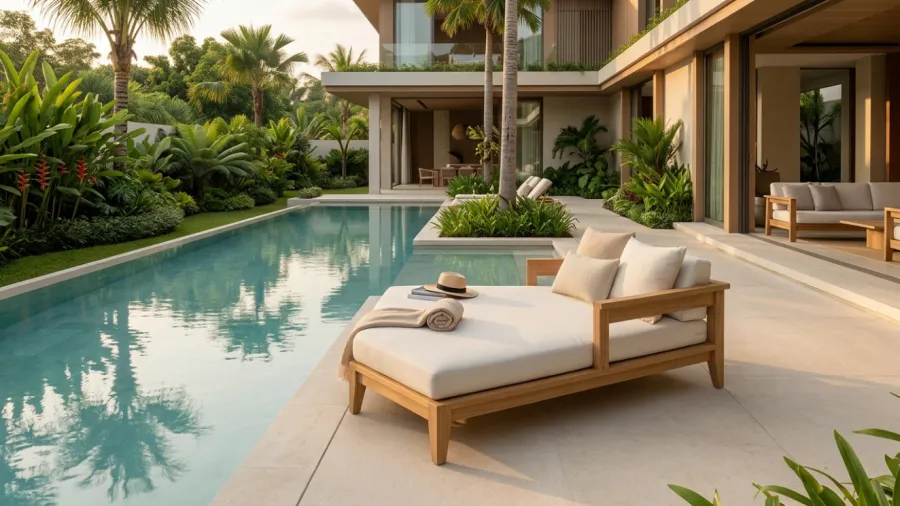
Poolside is one of the most natural locations for an outdoor daybed because the furniture can create a dedicated area for reclining, reading, relaxing, or spending time between swims.
The key is to position the daybed so it feels connected to the pool without interfering with movement around it.
Face the Main View
Where possible, orient the daybed toward the most attractive part of the pool, garden, landscape, or architecture.
The furniture does not always need to sit parallel to the pool edge. A slight change in orientation can create a more relaxed composition and improve privacy.
Keep Access Practical
Leave a clear route between the villa, pool, daybed, and other seating.
A visually impressive daybed quickly becomes inconvenient if people need to squeeze between furniture or walk around a large frame every time they use the pool.
Think About Shade as Part of the Layout
Shade can come from the architecture, a pergola, umbrella, planting, or the daybed itself.
Where shade needs to be integrated into the furniture, a canopy or umbrella-style configuration can create a more defined poolside lounge zone.
The goal is not necessarily to cover the daybed completely. It is to understand when and how the space will be used and position shade accordingly.
Create a Garden Daybed Retreat
A garden daybed works differently from poolside furniture. Instead of competing with an open view, it can use greenery, walls, planting, or landscape elements to create a quieter and more contained space. One effective approach is to position the daybed near the edge of the garden rather than directly in the centre. That can create a stronger sense of enclosure while leaving the central landscape open.

Use Greenery as a Backdrop
Planting behind or beside the daybed can visually anchor the furniture. The aim is not to surround it completely. Too much dense planting can restrict airflow, collect debris, and make access difficult. A balanced layout provides visual softness while keeping the furniture practical to reach and maintain.
Add a Small Functional Surface
A side table can make a garden daybed significantly more useful. It provides a place for drinks, books, phones, or small personal items without turning the area into a full outdoor living room.
Keep the Ground Condition in Mind
A daybed positioned over lawn, planting beds, or poorly drained ground may be exposed to more moisture and organic debris than one on a prepared terrace or deck.
For furniture placed directly within a garden environment, our garden furniture care guide explains the maintenance issues associated with rain, humidity, vegetation, cushions, and outdoor exposure.
Use a Daybed to Extend a Villa Terrace
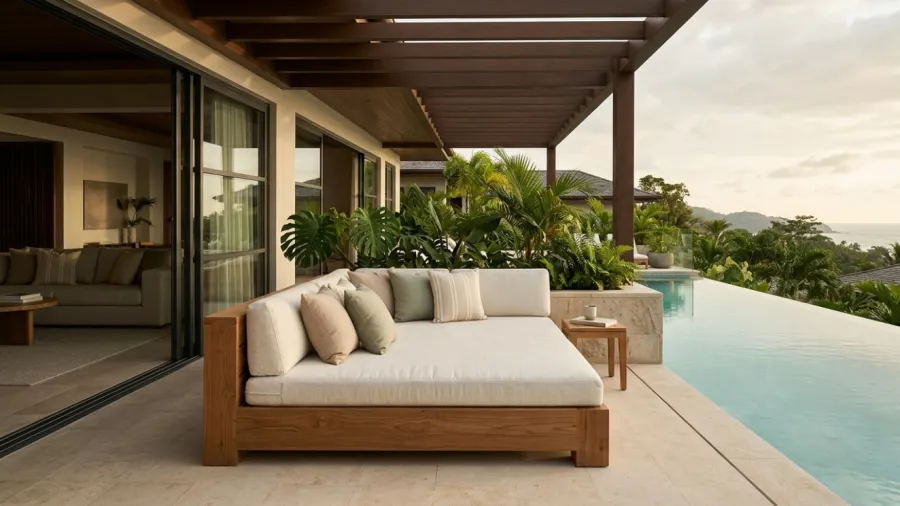
A villa terrace often sits between interior living spaces and the pool or garden. That makes it a useful place for an outdoor daybed because the furniture can help connect indoor comfort with outdoor relaxation. The strongest terrace layouts usually follow the architecture rather than compete with it.
A rectangular daybed can align naturally with:
- sliding doors;
- walls;
- roof lines;
- pool edges;
- existing sofas;
- long terraces.
If the interior has a clear design language, materials and cushion colours can continue that visual direction outdoors without trying to reproduce the interior exactly.
The goal is continuity rather than duplication. A covered terrace also allows the daybed to feel more like an outdoor lounge piece than a standalone pool accessory.
Outdoor Daybeds for Resorts and Hospitality Spaces
In hospitality settings, daybeds need to work as part of a larger layout.
A single daybed can be treated as a focal feature, but multiple units need rhythm, spacing, circulation, and visual consistency.
For example, a resort pool may use several similar daybeds along one side of the water rather than placing unrelated designs around the entire pool.
This creates a clearer visual system and can make the outdoor area easier to understand for guests.
When planning repeated daybed zones, consider:
- how guests enter and leave each seating area;
- whether staff can access the furniture easily;
- where side tables or umbrellas will sit;
- how daybeds relate to sun loungers and other seating;
- whether views remain open;
- whether one furniture type dominates the pool deck.
For larger villa, resort, restaurant, or hospitality projects, daybeds usually work best as one part of a broader custom outdoor furniture in Bali plan rather than being specified independently.
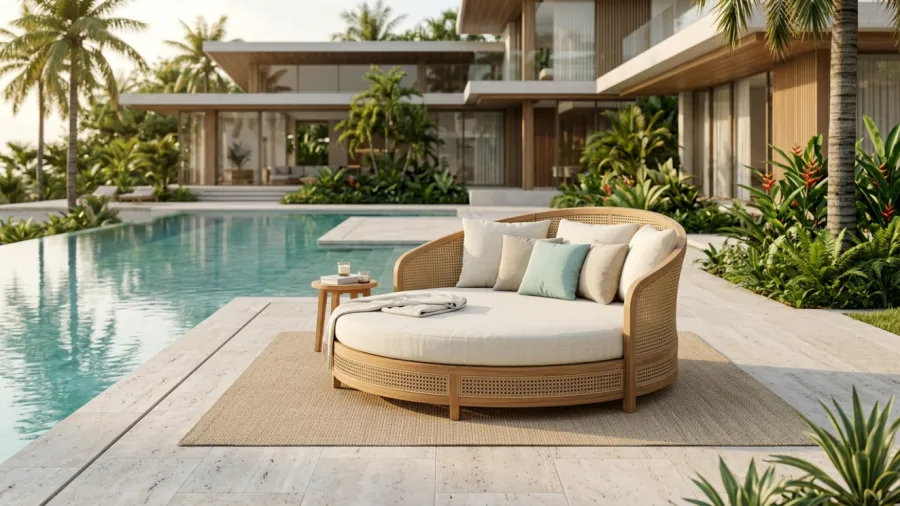
Round Daybeds as Visual Focal Points
A round daybed has a very different visual effect from conventional rectangular outdoor seating.
Because it does not align strongly with walls or architectural edges, it often works best where the furniture can stand more independently.
Suitable locations can include:
- broad pool decks;
- open gardens;
- larger terraces;
- central lounge areas;
- spaces with curved landscape features.
A round design can help break up an outdoor layout dominated by straight architectural lines.
The trade-off is space efficiency.
Circular furniture often needs more open space around it so the form remains readable and access does not feel restricted.
For a real product example, see this round outdoor daybed.
Rectangular Daybeds for Architectural Spaces
Rectangular daybeds are often easier to integrate into structured outdoor layouts.
They can align with:
- long terraces;
- pool edges;
- exterior walls;
- pergolas;
- covered verandas;
- other lounge furniture.
This makes them particularly useful when the outdoor furniture needs to feel integrated with the building rather than placed as an isolated feature.
Rectangular forms also allow several daybeds to be positioned in a repeated sequence more easily, which can be useful for hospitality spaces.
A solid wood daybed design provides one example of how a more substantial frame can create a strong architectural presence.
When a Canopy Daybed Makes Sense
A canopy changes both the function and visual character of an outdoor daybed.
It can create:
- more defined shade;
- a stronger sense of enclosure;
- greater privacy;
- a clear focal point.
But a canopy is not automatically an improvement.
In a compact space, a large overhead structure can make the furniture feel too heavy. Under an existing roof or pergola, it may simply duplicate shade that is already available.
A canopy works best when it solves an actual spatial or comfort requirement.
Before adding one, look at the complete environment: existing shade, architecture, views, wind exposure, and the scale of surrounding furniture.
Style the Daybed Without Overloading It
Outdoor daybeds already have a strong visual presence, so styling should usually be restrained.
Start with the main cushions.
Then add only the accessories that improve comfort or strengthen the overall design.
That might include:
- a small number of loose cushions;
- a side table;
- an umbrella;
- nearby planting;
- subtle outdoor lighting;
- a lightweight throw in a well-protected setting.
Avoid treating the daybed like an indoor sofa that needs multiple decorative layers.
Too many cushions, ornaments, lanterns, or accessories can make outdoor furniture harder to use and maintain.
A stronger approach is to let the frame, upholstery, landscape, and architecture provide most of the visual character.
Coordinate the Daybed With Other Outdoor Furniture
A daybed should not look like it belongs to a completely different project.
It does not need to match every outdoor chair or table exactly, but some design relationships help the overall space feel coherent.
These can include:
- similar frame finishes;
- related materials;
- consistent cushion tones;
- repeated shapes;
- compatible visual weight.
For example, a heavy solid-wood daybed surrounded only by extremely light metal seating can feel disconnected unless the contrast is intentional.
Likewise, using the same material everywhere can make a large outdoor scheme feel repetitive.
The better goal is visual relationship, not identical furniture.
If you are still determining whether teak, metal, woven materials, or mixed construction fits your wider outdoor concept, the outdoor furniture materials guide provides a deeper material comparison.

A Five-Point Check for Daybed Placement
Before finalising the position of an outdoor daybed, evaluate five practical relationships.
1. View
What will users see when sitting or reclining?
The pool, landscape, garden, architecture, or a private corner can all provide a useful orientation.
2. Access
Can people reach the daybed easily without walking through another seating area?
3. Shade
Will the location be comfortable at the times of day when it is most likely to be used?
4. Surroundings
Does the daybed have enough space to feel intentional rather than squeezed between other furniture?
5. Function
Does its position support what people actually want to do there—read, relax, socialise, enjoy the pool, or retreat from busier areas?
If one of these five relationships fails, moving the daybed slightly can sometimes improve the space more effectively than changing the furniture itself.
Common Outdoor Daybed Layout Mistakes
Good daybed design is often about avoiding a few predictable layout problems.
Blocking Circulation
A daybed should not sit directly across the natural route between the villa, pool, dining area, and garden.
Choosing Scale From a Product Photo
Furniture can look smaller online than it feels in a real outdoor setting.
Always judge the daybed in relation to architecture and surrounding furniture.
Putting Every Daybed in the Same Exposure
In a larger project, different locations may receive very different levels of sun, shade, rain, and wind.
The layout should acknowledge those differences.
Over-Styling the Furniture
Accessories should support comfort and atmosphere, not make the daybed difficult to use.
Ignoring What Happens Around the Daybed
Consider where people place drinks, towels, books, or personal items and how they approach the furniture.
A daybed can look attractive but still fail as a usable space if these practical details are ignored.
From Inspiration to the Final Daybed Specification
Inspiration and specification are different stages.
This page is about where a daybed can work and how it can shape an outdoor space.
Once you have identified the preferred setting and layout, the next questions become more technical:
- What dimensions fit?
- Which material suits the exposure?
- How deep should the cushions be?
- Does the design need a canopy?
- Should the piece be ready-made or custom?
- What maintenance routine is realistic?
Those decisions are covered in the guide to choosing the best Bali outdoor daybed.
Separating these two stages helps avoid choosing technical specifications before the role of the furniture in the space is clear.

Frequently Asked Questions About Outdoor Daybed Ideas
Where is the best place to put an outdoor daybed?
The best location depends on how the daybed will be used. Poolside areas benefit from convenient access and views, garden locations can prioritise privacy and greenery, while terraces often work best when the daybed follows the architecture and circulation of the property.
Can an outdoor daybed work in a small garden?
Yes, if the scale and placement are controlled. In a compact garden, a simpler daybed with a smaller visual footprint can work better than a large round or canopy design. Maintaining clear circulation is usually more important than adding extra accessories.
Should an outdoor daybed face the pool?
Not necessarily. Facing the pool can create a strong view, but the best orientation may also depend on shade, privacy, landscape, circulation, and surrounding furniture.
How should a daybed be styled in a villa?
Start with the architecture and surrounding furniture. Use cushions, colour, materials, planting, side tables, and lighting to create visual continuity rather than styling the daybed as an isolated decorative feature.
Build the Outdoor Space Around How It Will Be Used
A successful outdoor daybed is not defined only by its shape or material.
Its real value comes from the role it plays in the space.
Poolside, it can create a dedicated relaxation zone. In a garden, it can become a quieter retreat. On a villa terrace, it can extend the living area outdoors. In a resort or hospitality setting, repeated daybeds can help organise a larger pool or lounge environment.
Start with use, placement, views, access, and shade. Then develop the furniture design around those conditions.
If you are planning a wider outdoor scheme involving daybeds, loungers, sofas, dining furniture, or other custom pieces, explore our outdoor furniture in Bali guide.
And when you are ready to move from inspiration to actual dimensions, materials, cushions, and specifications, continue with the Bali outdoor daybed buyer’s guide.