
The best Bali outdoor daybed is not simply the one that looks most impressive. It is the one that fits the space, suits the way it will be used, provides the right level of comfort, and uses materials and finishes appropriate for its exposure.
For a private villa, that may mean a generous daybed beside a sheltered pool. A resort may need a design that works well with repeated guest use and routine housekeeping. A compact garden or terrace may require a smaller footprint that preserves circulation.
A practical way to choose is to evaluate the daybed in this order:
location → use → exposure → dimensions → material → comfort → maintenance → design.
Getting that sequence right helps avoid a common mistake: choosing a daybed mainly for its appearance and only later discovering that it is too large, too exposed, difficult to maintain, or poorly suited to the way the outdoor space actually works.
First, Match the Daybed to the Outdoor Setting
Where the daybed will be placed should influence almost every decision that follows.
A poolside daybed in an open area faces different conditions from one positioned beneath a covered terrace. A garden daybed may sit close to vegetation and damp surfaces, while an exposed deck may receive more direct sun, wind, and rain.
That is why choosing furniture for an outdoor space should begin with the site rather than the furniture catalogue.
Before deciding on materials or style, look at the location throughout the day:
- How much direct sun reaches the area?
- Can rain reach the frame and cushions?
- Is the space covered, partially covered, or fully exposed?
- Does water drain easily around the furniture?
- Is there enough airflow after wet weather?
- Will the daybed sit close to a pool, lawn, planting, or irrigation?
- How much circulation space needs to remain around it?
For broader planning beyond the daybed itself, the outdoor furniture in Bali guide covers furniture types, materials, outdoor applications, and custom project considerations.
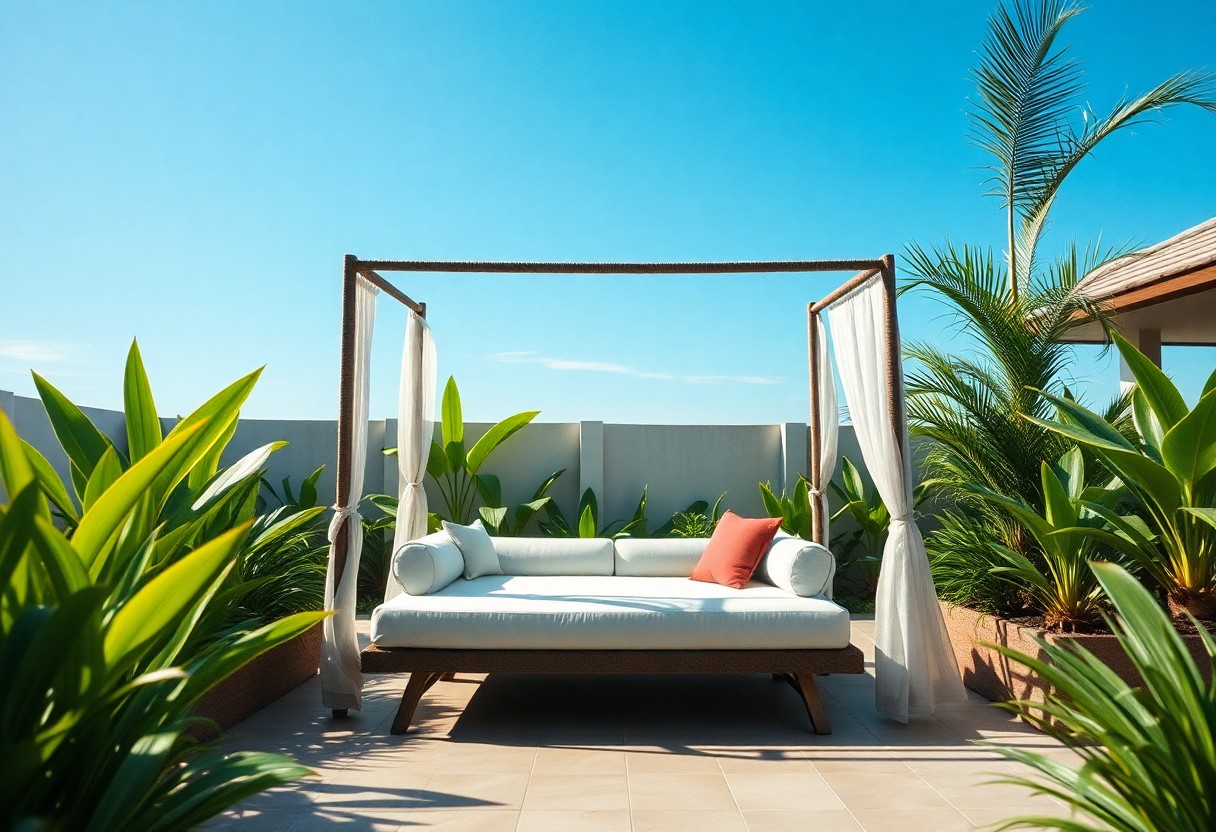
Choose the Daybed Around Its Main Use
An outdoor daybed can be used for reclining, reading, socialising, poolside relaxation, or simply creating a comfortable outdoor retreat.
Those uses sound similar, but they can lead to different furniture decisions.
A private villa may prioritise deeper lounging comfort because one or two people will spend longer periods relaxing on the daybed.
A resort or hospitality property may also need to consider repeated use, guest circulation, ease of cleaning, and visual consistency between multiple pieces.
In a restaurant, beach club, or shared outdoor lounge, an oversized daybed can become a circulation problem even when it looks impressive in photographs.
The first useful question is therefore:
What will people actually do on this daybed, and how frequently will it be used?
Once that answer is clear, size, shape, cushion depth, and material become much easier to evaluate.
A Quick Decision Guide for Different Outdoor Spaces
Different settings place different demands on a daybed. This matrix can help establish priorities before comparing individual designs.
| Outdoor Setting | Prioritise First | Then Evaluate |
|---|---|---|
| Fully exposed poolside | Weather exposure and cushion management | Drainage, material, shade |
| Covered villa terrace | Comfort and proportion | Design, fabric, surrounding furniture |
| Garden | Footprint and environmental exposure | Shade, drainage, easy cleaning |
| Resort or hotel pool | Repeated use and maintenance routine | Comfort, consistency, circulation |
| Compact terrace | Dimensions and movement around furniture | Shape, visual weight |
| Larger custom project | Layout and specification consistency | Materials, finishes, cushions, quantity |
This is also why there is no single “best outdoor daybed” for every property.
The best option is the one whose specification solves the requirements of its setting with the fewest unnecessary compromises.
Choose the Right Outdoor Daybed Size
A good outdoor daybed should feel generous without overwhelming the space.
Do not look only at the width and length of the frame. Consider the complete footprint once cushions, backrests, side structures, or a canopy are included.
Then consider the space people need to move around it.
For poolside areas, circulation between the daybed and pool edge should remain practical. On a terrace, furniture should not obstruct doors, walkways, or access to adjacent seating. In a garden, the daybed should fit comfortably within the landscape rather than dominating it.
Visual proportion matters too.
A substantial architectural villa may accommodate a larger daybed with a strong frame or canopy. The same design can feel heavy on a narrow terrace.
Conversely, a small daybed may appear visually lost on a broad resort pool deck.
There is therefore no universal daybed dimension that is right for every Bali property.
The better question is:
What size allows comfortable lounging while preserving the way people move through the space?
Custom sizing becomes especially useful when standard furniture dimensions do not align with the available layout.
Evaluate Sun, Rain, and Outdoor Exposure
Not all outdoor locations expose furniture to the same conditions.
A daybed beneath a roof may avoid most direct rainfall. A partially covered pool terrace may receive rain from certain directions. A garden or open pool deck can remain exposed for much longer periods.
This matters because exposure affects more than the frame.
It also affects:
- cushions;
- upholstery;
- surface finishes;
- cleaning frequency;
- drying;
- shade requirements;
- ongoing maintenance.
A fully exposed outdoor daybed should therefore be specified differently from a daybed that sits permanently beneath a covered terrace.
If the location already has a pergola, roof, large umbrella, or architectural overhang, a built-in canopy may be unnecessary.
If shade is limited, however, a canopy or separate shade solution may become part of the functional design rather than simply a decorative feature.
The key is to solve the actual exposure problem instead of assuming every outdoor daybed in Bali needs the same configuration.alue despite higher upfront costs. Consider maintenance requirements and replacement part availability when evaluating different options.
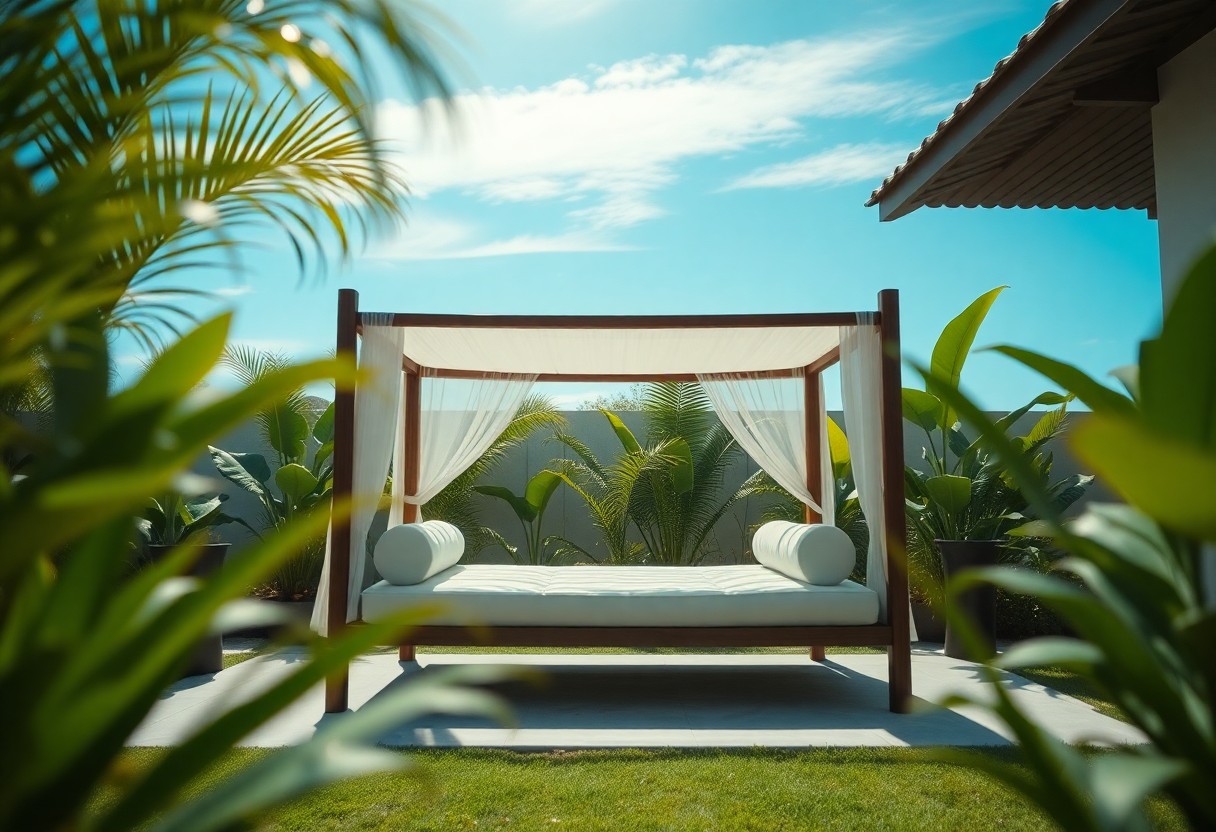
Compare Outdoor Daybed Materials by Context
Material choice influences appearance, weight, maintenance, construction possibilities, and how the daybed relates to surrounding furniture.
Common material directions for outdoor furniture include teak, synthetic rattan, powder-coated aluminium, outdoor rope, and combinations of these materials.
| Material Direction | Useful When You Want | Main Consideration |
| Teak | Warm, natural, substantial character | Appearance and finish need an intentional care approach |
| Synthetic rattan | Woven, relaxed, resort-oriented design | Weave and supporting frame both require appropriate cleaning |
| Powder-coated aluminium | Cleaner contemporary lines and lighter visual weight | Surface coating and construction quality matter |
| Outdoor rope | Textured, modern lounge character | Rope, frame, and cushions need to function together |
| Mixed materials | More design flexibility | Different components may require different care routines |
No material should be selected only because it is fashionable or commonly described as “outdoor.”
Instead, match the material to:
exposure + use + maintenance + design.
A teak daybed, for example, may suit a villa where a strong natural material is part of the architecture and furniture concept.
A lighter metal frame can make more visual sense in a contemporary setting.
Synthetic rattan or outdoor rope can create a softer woven appearance for certain resort or pool environments.
If material performance is a major part of your decision, read the more detailed guide to outdoor furniture materials, durability and maintenance before finalising the frame specification.
You can also compare a real solid wood Bali daybed example to see how material choice translates into an actual furniture form.
Do Not Treat Cushions as an Afterthought
The frame defines the daybed structurally, but the cushions often determine whether people enjoy using it.
Thicker does not automatically mean more comfortable.
Comfort depends on the relationship between:
- seat depth;
- cushion firmness;
- back support;
- reclining position;
- body posture;
- intended use.
A deep daybed can work particularly well for reclining but may feel less natural when someone wants to sit upright for conversation.
Cushion handling also matters outdoors.
If cushions can be removed, they are usually easier to clean, dry, or move to a protected location during prolonged wet conditions.
Fabric selection should also reflect how exposed the furniture will be. A cushion used beneath a covered terrace has a different risk profile from upholstery that remains beside an open swimming pool.
When specifying a Bali daybed, treat the frame, cushions, fabric, and exposure as one system rather than making each decision independently.
Round, Rectangular, or Canopy Daybed?
Shape affects both visual character and how efficiently a daybed uses space.
Rectangular Outdoor Daybed
A rectangular daybed generally aligns easily with architectural lines, pool edges, walls, and terraces.
It is often a practical option where furniture needs to integrate closely with an existing layout.
Round Outdoor Daybed
A round daybed creates a stronger focal point and can work well when furniture sits more independently within a garden or pool area.
The trade-off is footprint.
Circular furniture can occupy more usable surrounding space than its dimensions initially suggest.
For a practical reference, see this round outdoor daybed design.
Canopy Daybed
A canopy creates a more enclosed lounging area and can provide useful shade where the surrounding architecture does not.
However, it also changes the scale and visual weight of the piece.
Before choosing a canopy, assess:
- existing shade;
- available height;
- surrounding architecture;
- open-space exposure;
- overall furniture footprint.
A daybed with an umbrella shows another approach in which shade is integrated with the lounging function without relying on a fully enclosed canopy.
If you want broader inspiration on how different daybed configurations can work around villas, pools, gardens, and terraces, see outdoor daybed ideas for Bali spaces.
Think About the Space Around the Daybed
A daybed rarely works as an isolated object.
Its position affects surrounding furniture and vice versa.
Consider whether users need:
- a side table for drinks or personal items;
- convenient access from the pool;
- an umbrella or other shade;
- connection with outdoor lounge seating;
- a clear route toward the villa or garden;
- privacy without blocking circulation.
A beautifully designed daybed can still make the overall space worse if its placement creates awkward movement or leaves no practical room for other furniture.
This becomes especially important in hospitality projects, where several furniture types may need to work together across a pool, terrace, dining area, or garden.
The goal is not simply to fit a daybed into the available space.
It is to make the daybed part of a coherent outdoor layout.
Consider Maintenance Before You Buy
Maintenance is a buying criterion, not merely an aftercare issue.
The required routine will depend on the material, finish, cushions, location, and level of exposure.
A daybed beneath a covered terrace will usually require a different routine from one beside an open pool. Furniture near trees or planting may collect more leaves and organic debris. Removable cushions may need more active handling during extended periods of wet weather.
For a private residence, occasional hands-on maintenance may be acceptable.
For a villa, hotel, or resort, furniture may need to fit a simple housekeeping routine that staff can perform consistently.
That leads to an important decision rule:
Do not choose only for minimum maintenance. Choose a specification whose maintenance requirements are realistic for the property.
For cleaning, moisture management, inspection, and longer-term preventive care, use the Bali outdoor furniture maintenance guide rather than trying to solve every maintenance question during the buying stage.
Custom or Ready-Made Outdoor Daybed?
A ready-made outdoor daybed can be the sensible choice when its dimensions, materials, cushions, and design already work for the intended setting.
Custom manufacturing becomes more useful when the property introduces requirements that standard furniture cannot solve cleanly.
A custom outdoor daybed may be worth considering when:
- the available area requires specific dimensions;
- existing architecture dictates certain proportions;
- the furniture needs to coordinate with a wider collection;
- a particular frame material or finish is required;
- cushion dimensions need to match a specific use;
- the daybed needs an integrated canopy or shade solution;
- several matching pieces are required for a hospitality project.
Custom does not automatically mean better.
It means the specification can be adapted when standard dimensions or configurations would create unnecessary compromises.
What Should You Prepare Before Requesting a Custom Daybed Quote?
A useful quotation starts with a useful brief.
Before contacting a furniture maker, prepare as much of the following information as possible:
| Information | Why It Matters |
| Installation location | Establishes whether the furniture is indoors, covered, partially exposed, or fully exposed |
| Available dimensions | Prevents proposals that are too large or too small |
| Main use | Helps define seat depth, cushion arrangement, and configuration |
| Preferred material | Guides frame construction and design direction |
| Cushion requirements | Affects comfort and overall specification |
| Shade requirement | Determines whether a canopy, roof, or umbrella should be considered |
| Quantity | Important for residential versus hospitality requirements |
| Design reference | Helps communicate the intended visual direction |
| Existing furniture | Helps maintain consistency across the outdoor area |
This information also makes quotations easier to compare because different suppliers can respond to a more consistent specification.
What Determines the Cost of a Bali Outdoor Daybed?
There is no meaningful universal price for a custom daybed without knowing what is being specified.
Cost can vary according to:
- overall dimensions;
- frame material;
- construction complexity;
- finish;
- cushion specification;
- upholstery;
- canopy or shade details;
- custom design requirements;
- quantity.
For this reason, a quotation based on an actual specification is more useful than a broad online price range.
When comparing quotations, check whether they refer to equivalent materials, dimensions, cushions, finishes, and construction.
A lower figure attached to a different specification is not necessarily a like-for-like comparison.
Common Mistakes When Choosing an Outdoor Daybed
The wrong choice is often caused by one decision being made too early.
Choosing by appearance before measuring the space
A design can look balanced in a product image but feel oversized once installed.
Measure first and account for circulation around the furniture.
Assuming “outdoor” means every location is equivalent
A covered veranda and an exposed pool deck create very different conditions.
Specify the daybed for its actual environment.
Focusing on the frame but ignoring the cushions
The frame may last well while poorly matched upholstery becomes the main maintenance problem.
Evaluate both together.
Adding a canopy without checking existing shade
A canopy can be useful, but it can also add unnecessary size and visual weight where shade already exists.
Ignoring the maintenance routine
Furniture that looks appropriate on installation day may become inconvenient if its care requirements do not match how the property is managed.
Choosing each outdoor piece independently
For larger projects, inconsistent materials, proportions, and finishes can make an outdoor area feel fragmented.
Evaluate the daybed as part of the overall furniture plan.
Outdoor Daybed Selection Checklist
Before approving a design or requesting a final quotation, confirm:
- exact location;
- level of sun and rain exposure;
- main use;
- expected number of users;
- available footprint;
- circulation space;
- rectangular, round, or canopy configuration;
- frame material;
- finish;
- cushion depth and firmness;
- outdoor fabric requirements;
- removable or fixed cushions;
- shade requirements;
- realistic maintenance routine;
- relationship with other outdoor furniture;
- standard or custom sizing;
- quantity required;
- quotation inclusions.
If these decisions are clear, choosing the right outdoor daybed becomes much less dependent on guesswork.
Frequently Asked Questions About Bali Outdoor Daybeds
What is the best material for a Bali outdoor daybed?
There is no single best material for every project. The right choice depends on weather exposure, expected use, maintenance preferences, design direction, and how the frame works with the cushions and finish. Teak, synthetic rattan, powder-coated aluminium, and outdoor rope can all be appropriate in different situations.
Does an outdoor daybed need a canopy?
Not always. A canopy is useful when the daybed itself needs to provide shade or create a more enclosed lounging zone. If the space already has a roof, pergola, umbrella, or architectural shade, an open daybed may be more practical.
Should I choose a custom outdoor daybed?
Choose custom when standard products create compromises in dimensions, material, cushion configuration, shade, or design consistency. Ready-made furniture is perfectly reasonable when an existing design already fits the space and use well.
Is a Bali bed the same as an outdoor daybed?
The terms can overlap in everyday use, especially when referring to large lounging furniture used around pools, villas, gardens, and resorts. However, naming and design configurations vary. For a clearer explanation of the terminology and common forms, read what a Bali bed is and how it is used.
Choose the Daybed Around the Space, Not the Space Around the Daybed
The strongest Bali outdoor daybed choice starts with the location rather than the style.
Define how the furniture will be used. Understand how much exposure it will receive. Measure the available space. Compare materials in context. Specify the cushions as carefully as the frame. Then decide whether a ready-made design solves the requirements or whether custom dimensions and details are justified.
That sequence produces a better-informed decision than beginning with appearance alone.
Bali Best Buy Furniture is a Bali-based custom furniture company established in 2005, producing made-to-order furniture for residential, hospitality, commercial, and design projects.
If you are planning an outdoor daybed for a villa, pool, garden, resort, or hospitality project, start with the practical information: location, dimensions, exposure, preferred material, cushion requirements, quantity, and design reference.
For projects involving more than a daybed, explore the complete custom outdoor furniture in Bali guide to plan the wider furniture scheme.

