Furnishing a villa in Lombok begins long before you choose a sofa or dining table. A useful furniture plan starts with how the property will be used, what each room needs, and which pieces must fit the architecture precisely. Those decisions help you avoid overlooking storage, ordering furniture in the wrong dimensions, or committing to finishes before the spaces are ready.
Whether you are preparing a private holiday home, a rental villa, or a development with several units, the goal is the same: create a practical, coordinated list of furniture that supports the property—not simply a collection of attractive products. If you are already considering made-to-order pieces, explore custom furniture for homes and villas in Lombok alongside the planning steps below.
Start With How Your Villa Will Be Used
A two-bedroom villa intended for occasional family stays may need a different furniture arrangement from a two-bedroom property welcoming paying guests throughout the year. The room count might be identical; the storage, seating, cleaning requirements, and expected wear may not be.
Before making a shopping list, answer four questions:
- Who will use the property? Consider the typical number of occupants, their activities, and whether the villa is for private use, short-term rental, or longer stays.
- Which spaces will be used most? A villa built around outdoor entertaining may need more attention to terraces and dining areas than a property designed primarily for quiet stays.
- What must be stored? Think beyond clothing. Luggage, linen, cleaning supplies, and personal belongings may need dedicated storage.
- What is fixed already? Doorways, windows, electrical outlets, kitchen appliances, and finished walls affect furniture size and placement.
This is also the right moment to decide which furniture should share a design language. Consistency does not mean every bedroom must look identical; it means the proportions, materials, and finishes feel considered across the property.
Essential Villa Furniture, Room by Room
Use the following categories as a starting point, then adjust them to your villa’s layout and intended use. Not every item belongs in every project.
Bedrooms: Comfort, Storage, and Clear Circulation
A bedroom normally starts with the bed, but the surrounding details determine how comfortable the room will be to use. Consider the bed frame and headboard, bedside tables, wardrobe, luggage space, and, where appropriate, a desk or dressing area.
Check the relationship between the bed and the room rather than looking at bed size alone. Can people pass comfortably on both sides? Will wardrobe doors open without colliding with other furniture? Is there enough space to put down a suitcase without blocking circulation?
In compact rooms, built-in wardrobes or carefully sized bedside furniture may be more useful than multiple freestanding pieces. For rental use, look at how easily surfaces can be cleaned and whether guests have a sensible place for luggage and personal items.
Living Room: Plan Seating Around Real Activities
A living space might need a sofa, armchairs, a coffee table, side tables, a TV unit, or concealed storage. The right combination depends on the room’s shape and what people actually do there.
Start with the expected number of users and the main activity: conversation, watching television, reading, or moving between an indoor lounge and an outdoor terrace. Then check sightlines and pathways. A large sectional can look impressive in a render but make a narrow room difficult to navigate.
If standard sofa dimensions compromise the layout, a made-to-order configuration can help. If a ready-made sofa already fits the room and the intended use, there may be little reason to customise it.
Dining Area: Capacity Is Only the Beginning
For the dining area, record the intended seating capacity before deciding on table dimensions or shape. Include the dining table, chairs, and any sideboard or nearby storage that would serve a practical purpose.
Allow enough room to pull out chairs and move around the table. Check whether the dining area shares circulation with the kitchen, terrace doors, or main living space. The table must fit not only when all chairs are tucked in, but also when the room is in use.
For villas that regularly host groups, consider whether a fixed large table makes sense or whether a more flexible arrangement would serve the property better.
Kitchen: Make Cabinets Follow the Final Layout
Kitchen cabinetry requires a different level of planning from a freestanding dining table. Base cabinets, wall cabinets, pantry storage, an island, and bar seating all depend on the room’s final dimensions, appliance specifications, plumbing, and electrical positions.
Identify what will be stored and how the kitchen will be used before deciding on cabinet configurations. A visually striking island is not helpful if it interrupts movement between appliances or leaves insufficient working space.
For fitted cabinetry, architectural drawings are a useful starting point, but critical dimensions should be checked against the finished site before production specifications are finalised. Decisions about appliance sizes and service points should be coordinated with the relevant kitchen or construction professionals.
Outdoor and Poolside: Design for the Actual Exposure
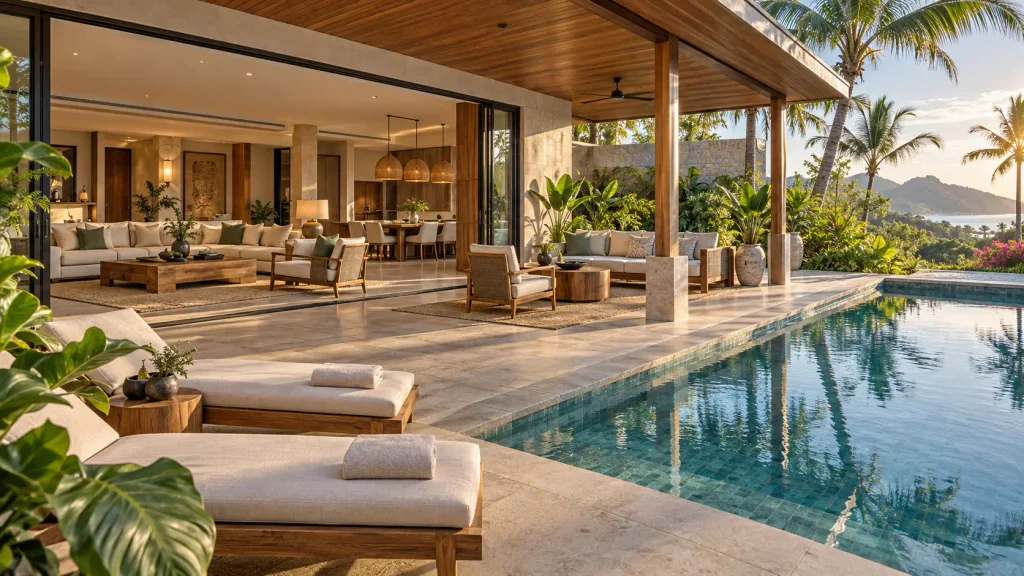
Lombok villas may have covered terraces, open pool decks, garden dining areas, or more exposed coastal spaces. These settings place different demands on furniture, even within the same property.
Typical pieces include outdoor dining tables and chairs, lounge seating, sun loungers, side tables, and daybeds. Start by deciding which activities each area should support and how much space must remain clear around the pool and circulation routes.
Then consider exposure. A covered terrace is not the same environment as a poolside area exposed to rain and strong sun. For coastal sites, salt-laden air may also influence the choice and maintenance of metal fittings, finishes, and upholstery components. Ask for material and finish specifications appropriate to the exact setting rather than assuming that every product labelled “outdoor” is equally suitable.
Bathrooms and Utility Areas: Do Not Overlook Storage
Bathroom vanities, mirror cabinets, linen cupboards, and service storage may be easy to leave off an early furniture list because they are not the visual centrepieces of a villa. Yet they can make a substantial difference to daily use.
Check which elements are built into the property and which must be supplied as furniture or cabinetry. Bathrooms require particular attention to moisture exposure and the interfaces between cabinetry, basins, plumbing, and wall finishes. For a rental villa, also plan where spare linen and housekeeping supplies can be stored without occupying guest-facing spaces.
Turn the Room List Into a Furniture Planning Matrix
A room-by-room list becomes far more useful when it captures what must be decided about each item. This does not need to be complicated software. A spreadsheet with one row per furniture item can be enough to organise the first conversation with a furniture maker.
The following is an illustrative example for a two-bedroom villa, not a completed Bali Best Buy Furniture project or a universal furnishing package.
| Room or area | Furniture item | Key decision to record | Priority |
|---|---|---|---|
| Bedroom 1 | Bed frame and headboard | Mattress size, wall position, clearance | Essential |
| Bedroom 1 | Wardrobe | Storage needs, door movement, available dimensions | Essential |
| Bedroom 2 | Bed frame and bedside tables | Occupancy, proportions, electrical points | Essential |
| Living room | Sofa and coffee table | Seating capacity, layout, circulation | Essential |
| Dining area | Dining table and chairs | Seating capacity, table shape, chair clearance | Essential |
| Kitchen | Cabinets and storage | Final dimensions, appliances, plumbing and power | Essential |
| Terrace | Outdoor lounge seating | Intended use, shade, weather exposure | Project-dependent |
| Poolside | Sun loungers | Layout, exposure, cleaning and maintenance | Project-dependent |
| Utility area | Linen or service cabinet | Operational storage requirements | Project-dependent |
For each item, add columns for quantity, approximate dimensions, material preference, finish, reference image, budget priority, and decision status. If several villas use the same furniture design, give that item a consistent code so quantities and variations are easier to track.
Mark anything still uncertain rather than guessing. For example, “wardrobe dimensions pending final wall measurement” is more useful than a precise dimension that has not been confirmed on site.
The finished matrix should make three things visible: what you need, what you have decided, and what must be clarified before an accurate quotation can be prepared.
Choose Materials Based on Use, Not Appearance Alone
Furniture materials should be assessed against the room, expected use, exposure, and willingness to maintain them. A material that works well in an air-conditioned bedroom may not be appropriate for an uncovered poolside setting without additional design and finish considerations.
For indoor furniture, compare options such as solid wood, engineered boards with suitable finishes, upholstery, and woven details according to the intended application. In kitchens, bathrooms, and other moisture-prone areas, pay close attention to the substrate, edges, joints, hardware, and finish system—not just the visible colour or texture.
For outdoor pieces, ask how the frame, fasteners, finish, cushions, and fabric will perform in the specific location. Teak, for example, is commonly considered for outdoor furniture, but its appearance and maintenance still depend on exposure and finishing choices. Natural rattan and synthetic woven materials should not be treated as interchangeable simply because they can look similar.
Rather than choosing a single “best” material for an entire villa, specify each category according to the conditions it will face. The goal is a coordinated appearance without ignoring practical differences between spaces.
Where Does Custom Furniture Make the Most Sense?
Custom villa furniture in Lombok can be especially useful when a piece must follow an unusual wall, fit a defined alcove, coordinate with architectural details, or repeat consistently across rooms or properties.
Consider made-to-order furniture when:
- A built-in wardrobe or cabinet needs to use a specific space efficiently.
- Standard sofa or dining-table dimensions interfere with circulation.
- Several bedrooms require related designs with different dimensions.
- A kitchen, vanity, or storage unit must integrate with fixed architectural elements.
- A multi-unit project needs consistent specifications across repeated furniture items.
Consider ready-made furniture when:
- A suitable size, material, and style already exist.
- The item is freestanding and does not need to integrate with the building.
- Immediate availability is more important than design customisation.
A mixed approach can be sensible. Prioritise custom production where fit, function, or consistency would otherwise be compromised, and use ready-made items where they meet the brief without unnecessary complexity.
To understand how made-to-order dimensions and finishes are developed, see BBBF’s overview of custom furniture. You can also browse furniture categories and design references to help communicate what you have in mind.
Set Furniture Budget Priorities Before Requesting Quotes
It is difficult to compare quotations when the furniture list is still changing. Instead of starting with a single estimated total, divide the scope into clear priorities.
Essential items are required for the villa to function as intended: beds, necessary storage, primary seating, dining furniture, and any required fitted cabinetry.
Custom-dependent items may need earlier decisions because their dimensions or installation affect other work. Kitchen cabinets and built-in wardrobes are common examples.
Optional items improve comfort or character but may not be critical to initial use, such as an additional lounge chair or decorative console.
Later-stage items can be selected when the main furniture layout and construction details are settled, provided they do not affect essential planning or site work.
When comparing proposals, check more than the total price. Confirm exactly which items, quantities, dimensions, materials, finishes, delivery arrangements, and installation requirements are included. A lower quote is not necessarily comparable if its scope is different.
There is no reliable universal cost for furnishing a Lombok villa without knowing its size, furniture requirements, specifications, and project location. A clear list is the starting point for a meaningful project-specific quotation.
Coordinate Furniture Decisions With Construction Progress
Furniture planning should begin while there is still time to make useful decisions, but ordering every piece before the site is ready can create avoidable complications.
A practical sequence is:
- Early layout stage: Identify furniture categories, intended room functions, and approximate positions from the architectural plans.
- Design development: Agree on the visual direction, priority items, material options, and any cabinetry that interacts with the building.
- Dimension confirmation: Check critical measurements against site conditions before finalising made-to-order specifications.
- Specification and quotation: Confirm quantities, dimensions, materials, finishes, inclusions, and the agreed scope.
- Delivery planning: Coordinate access and installation with the construction team, taking into account finishing work and protection of completed surfaces.
For a detailed explanation of the steps after the planning stage, read how to order custom furniture in Lombok. It covers the decisions that need to be made before production and delivery.
What to Prepare Before Contacting a Furniture Maker
You do not need a completely finished design to begin an enquiry. You will, however, receive a more useful response if you share what is already known and distinguish it from what is still undecided.
A practical initial brief includes:
- The villa’s location in Lombok and its intended use.
- A floor plan, if available, or clear room photographs.
- Your room-by-room furniture list and approximate quantities.
- Existing measurements, with notes identifying any that are not final.
- Reference images, preferred design direction, and material ideas.
- The stage of construction or renovation and a target installation period, if known.
- Any special requirements, such as repeatable furniture for multiple units or storage for rental operations.
You can begin with an incomplete list. The important thing is to explain the project clearly enough for the furniture maker to identify missing decisions and discuss the next steps.
Planning Villa Furniture in Lombok With Bali Best Buy Furniture
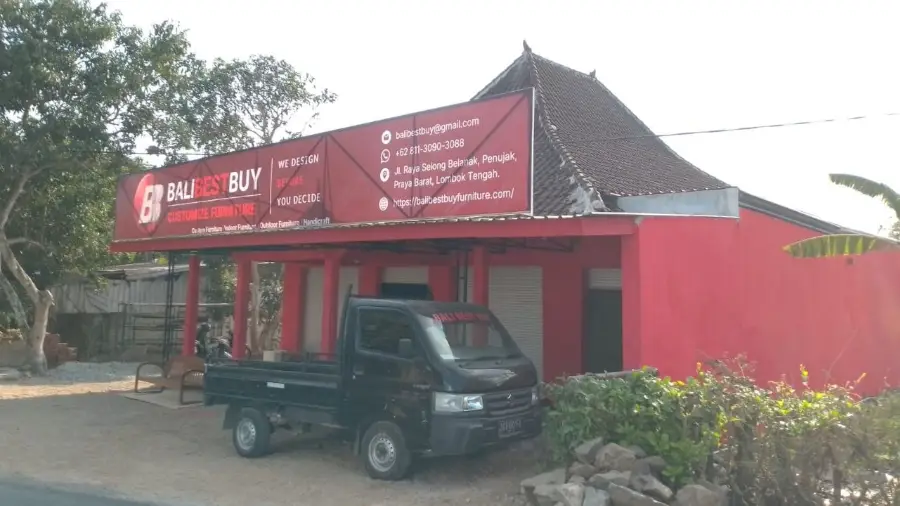
Bali Best Buy Furniture has produced made-to-order furniture since 2005 and has a branch in Central Lombok. Its furniture offering covers residential and hospitality needs, including beds, wardrobes, sofas, dining furniture, cabinetry, and outdoor pieces. Furniture requirements can be discussed using drawings, measurements, lists, or visual references.
For a documented example of the company’s work on the island, see the Boni Beach Restaurant furniture project in Selong Belanak, where BBBF produced custom teak dining tables and chairs. This is a hospitality reference, not an example of a full-villa furnishing package.
Planning furniture for a villa in Lombok? Share your floor plan, furniture list, approximate dimensions, or design references, along with your project location and current stage of work. The BBBF team can review your enquiry and discuss the next steps for your furniture requirements.