Planning custom furniture for a villa, private residence, restaurant, or resort in Lombok? One of the first questions is likely to be: How much will the furniture cost?
The answer depends on more than the furniture you choose. Dimensions, materials, construction methods, finishes, quantities, delivery arrangements, and installation requirements can all influence the final quotation.
Unlike ready-made furniture, which usually comes with a fixed retail price, custom furniture is priced around a specific design and project scope.
Understanding these factors can help you establish a realistic furniture budget, compare supplier quotations, and avoid unexpected costs.
This guide explains what affects custom furniture costs in Lombok, where budget differences arise, and what information to prepare before requesting a quotation.
What Determines Custom Furniture Costs in Lombok?
The cost of custom furniture in Lombok primarily depends on materials, dimensions, design complexity, finishing requirements, quantities, and the agreed delivery and installation scope.
A dining table with a simple rectangular top, for example, has different production requirements from a large solid-wood table with an irregular edge, detailed joinery, and a custom-designed base.
Even when two pieces look similar in photographs, their specifications may be substantially different.
The main pricing factors include:
| Pricing Factor | How It Affects Your Quotation |
|---|---|
| Furniture dimensions | Larger or thicker components may require more material and additional handling. |
| Material selection | Wood species, material quality, panel construction, and upholstery specifications affect cost. |
| Design complexity | Curved components, carvings, unusual shapes, and intricate details may increase production work. |
| Finishing requirements | Surface preparation, coatings, colours, textures, and finishing details influence production requirements. |
| Furniture quantity | Repeated designs may offer production efficiencies, depending on the project. |
| Hardware and accessories | Hinges, drawer systems, fittings, cushions, and specialised components affect the final specification. |
| Delivery and installation | Transportation, unloading, access conditions, assembly, and onsite installation may add costs. |
These factors are interconnected.
Choosing a different material may reduce the cost of one item, while changing its construction or finish can affect the overall quotation.
The most useful approach is to define what each furniture piece needs to achieve before selecting the specification.
1. Dimensions and Material Requirements
Furniture dimensions influence material consumption, construction requirements, transportation, and handling.
A large custom wardrobe may require more panels, hardware, internal compartments, and installation work than a simple freestanding cabinet.
Similarly, a long dining table may require additional structural support or a different construction approach depending on its material and design.
For built-in furniture, measurements are particularly important.
Walls, flooring, columns, and existing architectural features can affect the final dimensions. Changes to those measurements after production has started may require additional work.
Budget consideration: Confirm the required dimensions early, but distinguish preliminary measurements from final approved dimensions.
2. Design Complexity and Craftsmanship
Custom furniture allows greater design flexibility, but not every design requires the same production effort.
A straightforward bed frame with clean lines may involve fewer components than one featuring curved timber elements, integrated storage, specialised joinery, or extensive decorative detailing.
The same applies to restaurant furniture, cabinets, tables, and upholstered seating.
Design complexity can influence production because it may require:
- Additional material preparation or cutting.
- More detailed joinery and assembly.
- Custom components or specialised hardware.
- Extra finishing work.
- Additional design coordination and approvals.
The decision is not simply whether a design looks expensive.
It is whether its construction requirements align with the available budget and the intended use.
3. Finishing and Upholstery Specifications
Furniture finishing is part of the product specification, not merely a cosmetic detail.
Different finishes may involve different preparation, application, and finishing requirements.
For upholstered furniture, fabric selection, cushion construction, foam specifications, and removable covers can also affect costs.
A sofa intended for occasional residential use may have different requirements from seating used frequently in a hotel lounge.
When requesting a quotation, describe the intended environment as well as the appearance you want.
This gives the supplier a clearer basis for discussing suitable specifications.
How Material Choices Affect Your Furniture Budget
Material selection is one of the most important decisions when planning custom furniture prices in Lombok.
However, choosing a material based only on its reputation or perceived price can be misleading.
The final cost also depends on material dimensions, quality, availability, construction, finishing, and the design itself.
Teak Wood
Teak is widely used for furniture where natural timber appearance, strength, and durability are important considerations.
It can be suitable for dining furniture, bed frames, cabinets, and selected outdoor applications when the construction and finishing specifications are appropriate.
Teak quotations can vary according to the timber grade, dimensions, quantity, preparation, and construction requirements.
For example, a solid teak dining table and a table using a different structural configuration may have different material and production costs, even when their finished dimensions are similar.
For outdoor furniture, the specification should also consider moisture exposure, fittings, finish requirements, and maintenance.
Budget consideration: Specify the type and quality of teak being quoted rather than accepting a description that simply says “teak furniture.”
Suar Wood
Suar wood, also known as trembesi, is often chosen for furniture that emphasises natural grain patterns and substantial timber surfaces.
It is particularly associated with large dining tables and statement pieces.
However, a suar table is not automatically cheaper than a teak table.
The price depends on the slab dimensions, material quality, preparation, stability requirements, finishing, and base construction.
Large slabs can also influence handling and transportation requirements.
Budget consideration: If the natural character of a solid timber slab is the main design objective, compare suitable suar options against alternative materials with equivalent dimensions and finishing requirements.
Plywood and Engineered Wood
Plywood and other engineered wood products may be considered for certain cabinets, wardrobes, shelving systems, and built-in furniture.
Their suitability depends on the application, panel specifications, edge treatment, finishing system, and environmental conditions.
For example, a plywood cabinet with a particular decorative laminate may have different construction and finishing requirements from a solid-wood cabinet.
The choice should not be made on price alone.
Panel quality, moisture exposure, hardware requirements, and expected use should also be considered.
Budget consideration: Ask which panel material, thickness, finish, and edge treatment are included in the quotation.
Rattan, Metal, and Mixed-Material Furniture
Not all custom furniture needs to use one material throughout.
Dining chairs, lounge furniture, and other pieces may combine timber frames with rattan, metal components, upholstery, or other materials.
These combinations can create distinctive furniture designs, but their production costs depend on the specifications and work involved.
For instance, a chair with a woven backrest may require different production steps from a chair with a solid timber backrest.
Compare the complete design rather than assuming that fewer solid-wood components will always mean a lower quotation.
Choosing Materials Based on the Property
The most economical material is not necessarily the one with the lowest initial price.
For a private bedroom, visual preferences and everyday functionality may be the main priorities.
For a restaurant or resort, repeated use, cleaning requirements, and maintenance may carry greater weight.
For a coastal property in Lombok, furniture exposed to salt-laden air, humidity, sunlight, or rain may require particular attention to materials, fittings, finishes, and maintenance.
Choosing suitable specifications early can reduce the likelihood of making expensive changes later.
Custom vs Ready-Made Furniture: Which Offers Better Value?
Ready-made furniture often offers greater price certainty and faster availability, while custom furniture provides more control over dimensions, materials, appearance, and functionality.
Neither option is automatically the cheaper or better investment.
The right choice depends on your property, budget, and requirements.
| Consideration | Ready-Made Furniture | Custom Furniture |
|---|---|---|
| Initial pricing | Usually has a listed retail price | Based on agreed specifications |
| Dimensions | Limited to available sizes | Can be developed around the space |
| Design flexibility | Limited to existing collections | Greater control over the design |
| Material selection | Depends on available products | Can be specified for the project |
| Availability | May be available immediately | Requires production planning |
| Project consistency | Depends on matching stock | Repeated designs can be coordinated |
| Delivery and installation | Depends on retailer terms | Depends on the agreed project scope |
| Long-term value | Depends on product quality and suitability | Depends on construction quality, suitability, and maintenance |
When Ready-Made Furniture Makes Financial Sense
Ready-made furniture may be a practical option when:
- Standard dimensions fit the property.
- Suitable products are available within budget.
- The project has an immediate furnishing requirement.
- The available materials and finishes meet the intended use.
- Design consistency across multiple rooms is not a major concern.
For straightforward requirements, custom production may introduce complexity that the project does not need.
When Custom Furniture May Be Worth the Investment
Custom furniture becomes particularly relevant when the property has specific requirements that cannot easily be met through standard products.
Examples include unusual room dimensions, integrated storage, coordinated villa interiors, or restaurant furniture designed around a particular seating layout.
The value comes from the ability to control the furniture specification rather than simply purchasing an attractive product.
For a more detailed explanation of the available options, explore Bali Best Buy Furniture’s custom furniture services for Lombok properties.
Planning Furniture Costs for Villas and Hospitality Projects
A single custom dining table and a complete villa furnishing project require very different budgeting approaches.
For larger projects, the main challenge is often not the price of one item.
It is understanding the total furniture scope and deciding how to allocate the available budget.
Start With a Room-by-Room Furniture Budget
Consider a hypothetical three-bedroom villa in Lombok.
The property may require furniture for:
Bedrooms
Beds, bedside tables, wardrobes, desks, and selected seating.
Living Area
Sofas, coffee tables, TV cabinets, shelving, and storage furniture.
Dining Area
A dining table, dining chairs, and additional storage where required.
Outdoor Areas
Poolside loungers, outdoor seating, and terrace furniture.
The first step is to identify which items are essential and which can be introduced later.
A useful furniture budget separates these requirements into three categories.
| Priority | Furniture Category | Budgeting Approach |
|---|---|---|
| Essential | Beds, necessary storage, primary seating, dining furniture | Prioritise functionality and appropriate construction |
| Important | Additional cabinets, secondary seating, selected outdoor furniture | Balance design preferences with available funds |
| Optional | Decorative furniture, occasional tables, additional statement pieces | Consider after essential requirements are defined |
This prioritisation helps maintain control over the project without requiring every furniture decision to be made at once.
Avoid Treating Every Room as a Separate Project
When several rooms require similar furniture, using coordinated specifications may simplify production planning.
For example, guest bedrooms may share a bed frame design while allowing selected variations in size or finish.
However, repeated production does not automatically guarantee a discount.
Potential efficiencies depend on design consistency, quantities, production requirements, and the supplier’s quotation.
For larger projects, ask whether repeated items can be quoted as a coordinated furniture schedule rather than as unrelated individual orders.
Budget for Commercial Furniture Requirements
Hotels, resorts, restaurants, and cafés may place greater demands on furniture than private residential spaces.
A restaurant chair, for example, needs to suit the seating layout while accommodating frequent movement and everyday use.
A resort may require consistent furniture across multiple rooms while maintaining appropriate specifications for different areas.
When preparing a commercial furniture budget, consider the relationship between:
- The number of furniture units required.
- The intended frequency of use.
- Material and construction specifications.
- Cleaning and maintenance requirements.
- Replacement or repair considerations.
- Delivery and installation coordination.
For hospitality projects, the lowest initial quotation may not represent the lowest cost over the furniture’s useful life.
A more meaningful comparison considers suitability, maintenance requirements, and the possibility of future replacement.
A Real Lombok Furniture Project: Boni Beach Restaurant
Bali Best Buy Furniture has completed a custom furniture project for Boni Beach Restaurant in Selong Belanak, Lombok.
The documented scope included made-to-order teak dining tables and chairs for the restaurant area.
This illustrates how furniture can be developed around the practical requirements of a hospitality environment, including dining layouts, seating functionality, and a coordinated design direction.
The project does not establish a standard furniture price for other restaurants.
Each new quotation still depends on its own dimensions, quantities, designs, materials, and delivery requirements.
Explore the Boni Beach Restaurant furniture project to see an example of Bali Best Buy Furniture’s work in Lombok.
Delivery and Installation Costs in Lombok
Furniture production is only one component of the overall project budget.
For furniture manufactured in Bali and delivered to Lombok, transportation arrangements and onsite requirements may influence the final cost.
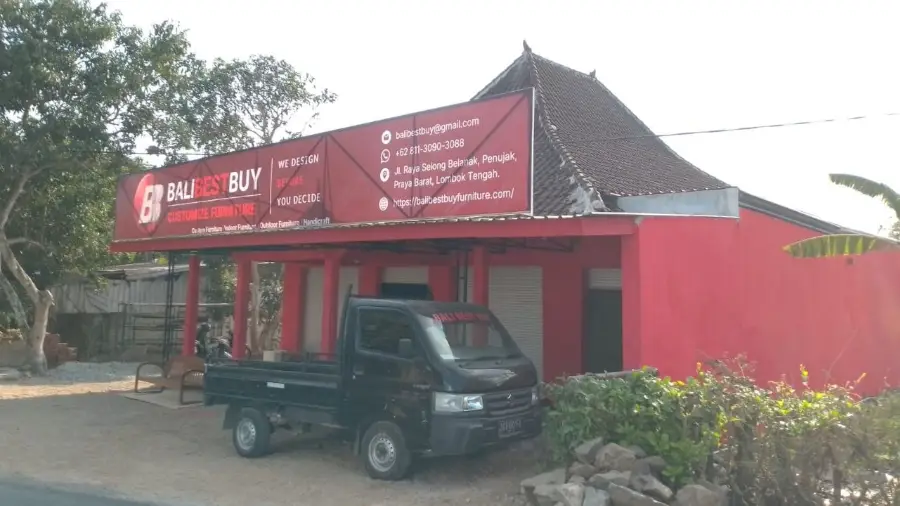
Bali Best Buy Furniture has an established operation in Bali and a branch in Central Lombok, supporting furniture enquiries and projects on the island.
However, the exact delivery and installation scope should be confirmed for each quotation.
Transportation and Handling
Transportation requirements may depend on the number of items, their dimensions, packaging, handling needs, and the destination.
A single large dining table may present different logistical requirements from multiple smaller pieces of furniture.
Items that require additional protection, careful handling, or specialised unloading may also affect the delivery arrangement.
Ask your supplier whether the quotation includes transportation to the actual property or only to a specified delivery point.
Property Access and Installation
The location and condition of your project site can influence delivery planning.
Before finalising a quotation, consider:
- Can delivery vehicles access the property?
- Are there narrow roads, steep entrances, or restricted unloading areas?
- Will large furniture fit through doors, corridors, and staircases?
- Does any furniture require assembly or installation onsite?
- Is the property ready to receive the furniture?
- Will storage or additional handling be necessary?
For properties in areas such as Kuta Mandalika, Selong Belanak, Senggigi, or other parts of Lombok, the actual site conditions matter more than the destination name alone.
Avoid assuming that delivery to every location involves the same requirements.
Clarify What Installation Includes
The term “installation” can describe different levels of service.
For example, placing a freestanding dining table in a room is different from installing fitted cabinetry that requires alignment, hardware adjustment, or wall fixing.
Before accepting a quotation, confirm whether the agreed price includes unloading, assembly, positioning, installation, and any necessary onsite adjustments.
Budget consideration: Request a clear explanation of delivery and installation inclusions and exclusions before comparing supplier totals.
How to Compare Custom Furniture Quotations in Lombok
When comparing custom furniture quotations, the most important question is not simply, “Which supplier has the lowest price?”
It is: “Are these quotations based on the same specifications and scope?”
Two suppliers may provide different prices for furniture that appears nearly identical in a reference photograph.
But one quotation may include solid timber construction, particular hardware, and delivery services, while another uses different materials or excludes installation.
Comparing the totals without reviewing those differences can lead to an inaccurate assessment.
Use a Like-for-Like Quotation Comparison
Before deciding between suppliers, review these details:
| Quotation Element | What to Check |
|---|---|
| Item description | Is each furniture item clearly identified? |
| Dimensions | Are the quoted sizes the same? |
| Quantity | Are the same numbers of units included? |
| Materials | Are the wood, panels, upholstery, and other materials specified? |
| Construction | Are relevant structural details and hardware identified? |
| Finishing | Are colours, coatings, textures, and finishes defined? |
| Drawings and revisions | Are design approvals or revisions included? |
| Transportation | Is delivery to the Lombok property included? |
| Installation | Are unloading, assembly, and installation included? |
| Schedule | Are the production and delivery assumptions clear? |
| Payment | Are payment stages and conditions specified? |
| After-sales support | Are the applicable service or warranty terms explained? |
A quotation with fewer details is not necessarily less expensive for the same product.
It may simply leave more questions unanswered.
Request Alternatives When the Budget Is Too High
If a quotation exceeds your planned furniture budget, changing suppliers is not the only option.
You can also ask whether the design can be adjusted while retaining its main functional and visual requirements.
Potential alternatives include simplifying decorative details, reviewing material specifications, changing selected hardware, or postponing non-essential pieces.
However, cost reductions should not compromise important structural requirements or the suitability of furniture for its intended environment.
The aim is to optimise the specification—not automatically choose the cheapest possible construction.
How to Keep Your Furniture Project Within Budget
A well-managed furniture budget starts with decisions made before production.
One of the most useful approaches is to distinguish essential specifications from preferences that can be adjusted.
Establish Your Budget Priorities
Instead of treating every furniture item as equally important, identify where durability, functionality, and design will have the greatest impact.
For example, frequently used restaurant seating may justify different spending priorities from occasional decorative furniture.
For a villa, practical storage and comfortable sleeping furniture may take priority over secondary decorative pieces.
Your furniture budget should reflect how the property will actually be used.
Separate the Base Scope From Optional Items
Ask suppliers to distinguish essential furniture from optional additions where practical.
This makes it easier to understand the financial impact of adding, removing, or modifying individual pieces.
It also helps prevent the total quotation from becoming difficult to interpret as the project develops.
Finalise Specifications Before Production
Late design changes can create additional costs when they require new materials, revised components, or additional production work.
Confirm important decisions—including dimensions, materials, finishes, and quantities—before approving the final production scope.
For a detailed explanation of this process, read our guide on how to order custom furniture in Lombok.
Allow for Unresolved Project Requirements
If architectural measurements, site access, or installation conditions are still uncertain, identify those uncertainties early.
An initial quotation based on preliminary information may need revision once the final specifications are confirmed.
For larger projects, it is sensible to keep a separate allowance for approved changes or requirements that have not yet been fully defined.
This allowance is part of your own project budgeting—not an additional BBBF charge.
How to Request an Accurate Custom Furniture Quotation in Lombok
The more clearly you describe your furniture requirements, the easier it is for a supplier to prepare a relevant quotation.
You do not necessarily need completed architectural drawings or a final interior design package to start an enquiry.
However, providing useful project information can reduce uncertainty and help the supplier understand your intended scope.
What Information Should You Prepare?
Start with the following details where available.
1. Property type and location
Explain whether the furniture is for a villa, private residence, resort, restaurant, café, or another property.
Include the project location in Lombok.
2. Furniture list and quantities
Identify the items you need and how many units are required.
For multiple rooms, a simple room-by-room list is helpful.
3. Approximate dimensions
Provide the proposed dimensions of each item.
If measurements are preliminary, identify them as such.
4. Design references
Share photographs, sketches, mood boards, or architectural drawings that communicate your preferred furniture style.
5. Material preferences
Mention any preferred materials, such as teak, suar, plywood, rattan, or upholstery.
If you are unsure, explain how the furniture will be used so suitable options can be discussed.
6. Intended budget
If you have a target furniture budget, sharing it may help establish which requirements or specifications need closer review.
A budget does not need to be treated as a fixed spending commitment. It can serve as a planning reference.
7. Project schedule
Include your anticipated installation period or property opening date if known.
For properties under construction, explain whether the site is ready for measurement, delivery, or installation.
Can You Request a Quotation Without Final Drawings?
Yes. An initial enquiry can begin with reference images, a furniture list, and available measurements.
However, the information may not yet be sufficient for a final, fully specified quotation.
If important details remain unresolved, the supplier may need to clarify the scope before confirming the price and production arrangements.
The objective is to develop a quotation that accurately reflects what you intend to order.
Requesting a Quotation From Bali Best Buy Furniture
Bali Best Buy Furniture is a custom furniture company established in Bali in 2005.
The company produces made-to-order furniture for residential and commercial properties, including villas, restaurants, resorts, hotels, and private homes.
With an established Bali furniture operation and a branch in Central Lombok, the company can discuss custom furniture requirements for projects on the island.
Rather than presenting a universal price list for made-to-order furniture, the appropriate starting point is to review the specific project requirements.
Depending on the scope, relevant information may include drawings, furniture quantities, dimensions, materials, finishing requirements, and delivery arrangements.
You can explore the company’s Lombok furniture services for more information about its made-to-order furniture offering.
Why Project-Specific Quotations Matter
A quotation based on your actual requirements helps establish a clearer basis for discussing furniture specifications, production scope, and delivery arrangements.
This is particularly useful for villa owners, property developers, architects, interior designers, and hospitality operators comparing different suppliers.
It allows the purchasing decision to focus on what will be supplied rather than an isolated price figure.
Frequently Asked Questions About Custom Furniture Costs in Lombok
Is custom furniture more expensive than ready-made furniture?
Not necessarily. Custom furniture and ready-made furniture have different pricing structures. Custom furniture costs depend on the specifications and production requirements, while ready-made furniture typically has an established retail price. Compare the materials, construction, suitability, and total delivered cost before deciding.
Can I request different material options for the same furniture design?
You can ask whether alternative materials are suitable for your design. The available options depend on structural requirements, dimensions, intended use, and finishing preferences. A supplier should assess those considerations before recommending a substitute.
Are delivery and installation included in a custom furniture quotation?
Not automatically. Delivery and installation inclusions depend on the supplier and agreed project scope. Ask whether transportation, unloading, assembly, positioning, and installation are included or quoted separately.
Can furniture costs change after a quotation is issued?
They can if the agreed scope changes or if the original quotation was based on preliminary information. Changes to dimensions, materials, quantities, finishes, or delivery arrangements may affect pricing. Review the quotation’s validity and revision conditions before approving an order.
Should I request a quotation for the whole villa or individual items?
Either approach may be appropriate. If you are furnishing several rooms, a consolidated furniture schedule can make it easier to compare the overall project scope and identify repeated designs. For a small requirement, an individual-item quotation may be sufficient.
Planning Custom Furniture in Lombok? Get a Quotation Based on Your Project Requirements
Understanding custom furniture costs is the first step towards making a more informed purchasing decision.
The next step is to define the furniture you need, the specifications that matter, and the budget priorities for your property.
Whether you are furnishing a private villa, preparing a restaurant, or developing a hospitality property, a clear project brief provides a stronger foundation for discussing your quotation.
Bali Best Buy Furniture can review your custom furniture enquiry for a project in Lombok.
Share your available furniture list, measurements, drawings, or reference images. Include your project location, preferred materials, and intended schedule where possible.
You do not need every detail finalised to start the conversation.
REQUEST YOUR LOMBOK FURNITURE QUOTATION ON WHATSAPP
Tell us what you are planning, and we can discuss the information needed to move your furniture enquiry forward.