
Knowing how to furnish a villa in Bali means turning a finished building into a comfortable, durable, and income-ready space — covering indoor and outdoor furniture, lighting, storage, décor, and installation. The process comes down to four decisions: your guest profile, a realistic budget, climate-appropriate materials, and a complete room-by-room plan. As a benchmark, most projects range from roughly USD 10,000 for a compact villa to USD 100,000+ for a luxury estate.
This Bali villa furniture guide walks owners, investors, and developers through the entire journey — from first budget to final installation — and links to deeper resources for every step. Whether you are preparing a private retreat or a high-occupancy rental, the same sequence keeps projects on budget and on schedule.
What Does Furnishing a Villa in Bali Involve?
Furnishing is far more than buying beds and sofas. A complete villa furnishing Bali project typically covers indoor furniture (bedroom, living, dining), outdoor and poolside furniture, kitchen cabinetry and bar stools, wardrobes and built-in storage, lighting, mirrors, soft furnishings, and decorative accessories — plus delivery, styling, and installation.
The scope grows with both the size of the property and its commercial ambition. A private residence can prioritise personal taste and a few statement pieces, while a rental villa must treat every purchase as an operating asset that will be used, cleaned, photographed, and reviewed hundreds of times a year.
Consider two identical three-bedroom villas in Seminyak: one furnished for personal weekends, the other for nightly rental. The rental version needs extra dining chairs, hospitality-grade mattresses, additional storage, and weather-resistant outdoor seating — often 20–30% more items for exactly the same floor plan. That is why the first question is never “what looks good?” but “who is this villa for, and how hard will the furniture work?” Answering it wrong inflates both the upfront bill and years of replacement costs.
How Much Does It Cost to Furnish a Villa in Bali?
As a planning benchmark, furnishing budgets in Bali generally fall in these illustrative ranges (figures vary with quality, design, and scope):
| Villa Size | Illustrative Furnishing Budget (USD) |
|---|---|
| 1 Bedroom | 10,000 – 25,000 |
| 2 Bedrooms | 20,000 – 45,000 |
| 3 Bedrooms | 35,000 – 80,000 |
| 4–5 Bedrooms | 60,000 – 150,000 |
| Luxury Estate | 150,000+ |
These figures are starting points, not quotes. When owners first research how to furnish a villa in Bali, cost is almost always the opening question — but the headline number hides the real driver: quality tier. The same 3-bedroom villa can land near USD 40,000 with mid-range pieces or cross USD 120,000 once you specify bespoke teak, designer lighting, and imported décor.
For a detailed breakdown by category, scenario (basic/mid/luxury), and the hidden costs that wreck budgets, see our full guide on the cost to furnish a villa in Bali. The key takeaway for investors: total ownership cost — durability, maintenance, and replacement frequency — matters far more than the lowest sticker price, because a cheap outdoor sofa replaced twice a year quickly costs more than a quality one bought once.
How Do You Plan a Realistic Furnishing Budget?
A structured budget prevents the most common failure mode: overspending on visible “hero” pieces while under-investing in mattresses, storage, and outdoor furniture. The fix is simple — allocate funds across categories before requesting a single quote, not after you have fallen for a sofa.
On a USD 50,000 budget for a 3-bedroom rental, that discipline would steer roughly USD 22,000–27,000 into core furniture, USD 5,000–7,500 outdoors, and a USD 2,500–5,000 contingency you will almost certainly use. A simple, balanced split many owners follow:
- Furniture (indoor): 45–55%
- Outdoor furniture: 10–15%
- Lighting: 5–10%
- Décor & accessories: 10–15%
- Window treatments: 5–10%
- Delivery & installation: 5–10%
- Contingency reserve: 5–10%
For the full method — including hidden costs like sea/air logistics, window treatments, and replacement reserves — work through our villa interior budget guide before you buy anything. Owners who set these percentages first rarely blow the budget; those who buy piece by piece almost always do.
What Furniture Do You Actually Need? (Room-by-Room)
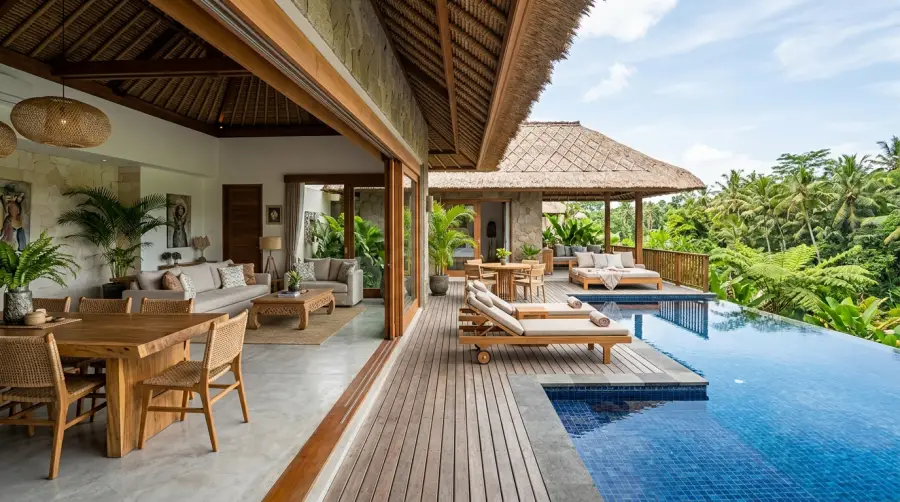
The fastest way to avoid forgotten items and duplicate orders is to plan the whole property at once, room by room: living room, bedrooms, dining, kitchen, bathrooms, outdoor areas, and an optional home office for long-stay and digital-nomad guests. The big pieces are easy to remember; it is the small ones — luggage racks, bedside lamps, outdoor side tables, cushion storage, entry console — that get missed, and each gap quietly chips away at guest reviews.
There is also a commercial reason to list everything upfront: one consolidated order is cheaper to produce, ship, and install than a series of last-minute top-ups. Work from our complete villa furniture checklist so every room is fully equipped before procurement begins — and so your manufacturer can quote the whole project in a single pass.
How Do You Choose Furniture for a Rental Villa?
Rental villas are a business, not a personal home. A sofa used a few hours a day in a private house may host hundreds of guests a year in a rental, so the selection criteria shift to durability, ease of maintenance, guest comfort, cleaning efficiency, and replacement cost.
In practice that means hospitality-grade construction, performance fabrics that wipe clean between stays, and weather-resistant outdoor pieces that survive monsoon season. The payoff is measurable: furniture that photographs well and holds up protects both your review score and your nightly rate, while flimsy pieces generate complaints, refunds, and downtime. Detailed selection criteria — including the best materials for Airbnb villas — are covered in our guide to furniture for rental villas.
What Are the Most Common Furnishing Mistakes to Avoid?
Most overspending comes from poor planning, not poor taste. The recurring mistakes across Bali projects are predictable: buying before finalising the layout, choosing residential furniture for rentals, underestimating outdoor furniture, ignoring storage, and prioritising looks over durability in a tropical climate.
Each one carries a price tag. Residential-grade sofas in a high-occupancy villa can fail within a season; skipped storage forces an expensive redesign after opening; the wrong outdoor finish means annual replacements. Before committing budget, read the full list of villa furnishing mistakes — avoiding even two or three of them typically saves thousands over a property’s life and spares you the operational headache of mid-season repairs.
Which Materials Work Best in Bali’s Climate?
Bali’s humidity, intense UV, seasonal rain, and coastal salt air punish the wrong materials quickly — this is where furnishing budgets are quietly won or lost. Reliable choices include:
- Teak wood — highly durable, excellent for indoor and semi-outdoor use; the benchmark for premium and luxury villas.
- Synthetic rattan — the rattan look with far less maintenance, ideal outdoors.
- Powder-coated aluminium — rust-resistant frames for poolside furniture.
- Performance fabrics — stain- and moisture-resistant upholstery for high-turnover rentals.
Matching material to exposure — indoor versus poolside versus beachfront — is one of the highest-leverage decisions in the whole project. A beachfront villa in Uluwatu, for instance, needs powder-coated aluminium and synthetic rattan outdoors where solid timber would grey and crack, while an inland Ubud villa has more freedom. Specifying the right material per zone upfront is the single cleanest way to cut a property’s lifetime replacement spend.
Custom vs Ready-Made: Which Should You Choose?
Custom furniture maximises space, fits unusual layouts, and builds a distinctive identity for luxury and rental positioning — but it costs more and takes longer to produce. Ready-made is faster and cheaper upfront and easier to replace, at the cost of fit and individuality.
Most successful projects use a hybrid: custom for major and built-in pieces (beds, wardrobes, storage that must fit the architecture) and ready-made for decorative or easily replaced items. Investors furnishing an entire property often choose a complete villa furniture package, which bundles design, production, delivery, and installation under one accountable partner — keeping the design language consistent and removing the coordination risk of juggling multiple suppliers across an island with complex logistics.
Working With a Bali Furniture Manufacturer
Consider a realistic scenario: a new three-bedroom rental villa in Canggu spends heavily on custom indoor furniture but picks the cheapest outdoor set to save money. Within a year the outdoor pieces fade and crack, replacements eat the supposed savings, and a handful of reviews mention a tired pool area — exactly the space guests photograph most. A single manufacturer handling both indoor and outdoor scope, with climate-appropriate materials and one installation timeline, would have prevented the entire chain of problems.
That is the practical advantage of learning how to furnish a villa in Bali with a local maker who understands tropical conditions and hospitality standards: consistent design language, materials matched to each zone, and one accountable partner from the first drawing to final installation. For overseas investors especially, that single point of contact is often worth more than a marginally cheaper quote stitched together from a patchwork of suppliers.
Planning a villa project in Bali? Get a free, no-obligation furnishing estimate from Bali Best Buy Furniture — custom and ready-made, indoor and outdoor, delivered and installed. Request a quote or message us on WhatsApp at +62 811-3090-3088.
How to Furnish a Villa in Bali: A Quick Action Plan
- Define your guest profile and positioning (private, family rental, luxury, long-stay).
- Set a realistic budget and allocate it by category.
- Build a room-by-room checklist.
- Select climate-appropriate materials.
- Decide custom vs ready-made (or hybrid).
- Confirm delivery, installation, and a replacement reserve.
Furnishing order that works: Guest needs → Budget → Functionality → Durability → Design.
FAQ
How much does it cost to furnish a villa in Bali?
Most projects range from about USD 10,000 for a compact villa to USD 100,000+ for luxury properties, depending on size, quality, and customisation. See our detailed cost guide for a category-by-category breakdown.
How long does furnishing a villa take?
It depends on scope and how much is custom-made. Ready-made setups can be installed quickly, while custom production for a full villa typically requires several weeks of design, fabrication, finishing, and installation.
What is the best material for villa furniture in Bali?
Teak wood is the most reliable all-rounder for tropical conditions, supported by synthetic rattan, powder-coated aluminium, and performance fabrics for outdoor and high-use areas.
Should I buy a complete villa furniture package?
For investors furnishing a whole property, a package simplifies procurement, keeps the design consistent, and consolidates delivery and installation under one partner.
Is custom furniture worth it for a rental villa?
Often yes for major and built-in pieces, where fit, durability, and identity matter most. A hybrid of custom and ready-made usually delivers the best balance of cost and flexibility.
Can I furnish a villa in Bali from overseas?
Yes. Many investors furnish remotely by approving a floor plan, material samples, and a 3D layout, then leaving production, delivery, and installation to a local manufacturer. A complete villa furniture package plus clear photo documentation makes remote projects straightforward.
Where should I start when furnishing a villa in Bali?
Start by defining your guest profile and budget, then build a room-by-room checklist before requesting quotes. This guide and the linked resources cover each step in order, from cost planning to material selection and installation.